01 / Case study
RevenueGuard AI
Transaction risk intelligence for faster, more explainable investigations.
Overview
The project in context.
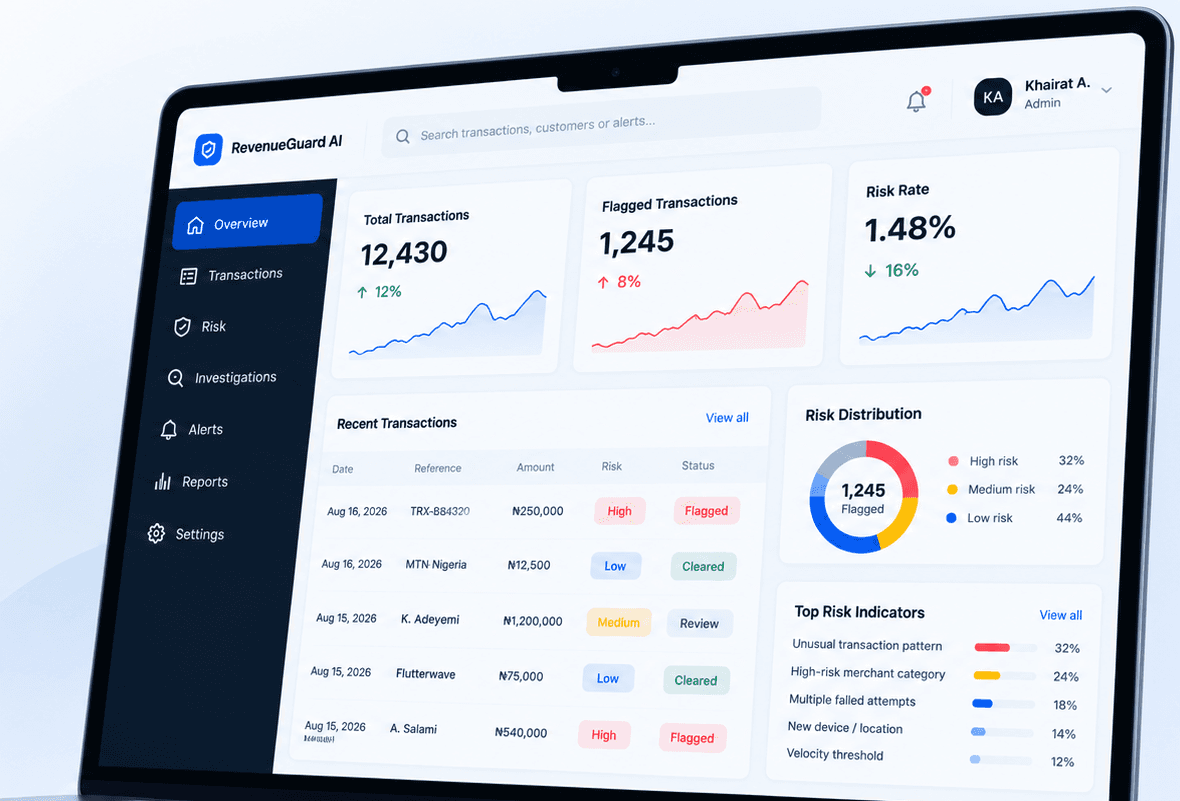
RevenueGuard AI is a transaction-risk intelligence platform designed to help teams identify suspicious activity, understand why it deserves attention and investigate it with better context.
It brings together risk signals, investigation workflows and AI-assisted analysis so a flagged transaction becomes more than an alert. It becomes a clearer starting point for investigation.
The problem
Risk alerts need context.
An alert can tell an investigator that something looks unusual, but it does not automatically explain what happened, why it matters or what should be reviewed next.
RevenueGuard focuses on the gap between detecting risk and understanding it, bringing signals, transaction context and investigation information into one clearer workflow.
What I built
A risk workflow, not just a dashboard.
- Transaction monitoring: Evaluate transaction activity against risk signals and surface events that deserve attention.
- Risk context: Show the information contributing to risk instead of presenting an unexplained score alone.
- Investigation workflows: Give flagged activity a structured path from detection through review and follow-up.
- AI-assisted analysis: Use AI to turn available transaction context and signals into clearer investigative explanations.
- Risk visibility: Present risk information in a structured way that makes patterns and investigation activity easier to understand.
How it works
From transaction activity to investigation context.
- 01 / Transaction activity: Relevant transaction information becomes available for evaluation.
- 02 / Risk signals: The system evaluates conditions that may indicate unusual behaviour.
- 03 / Risk context: Signals and transaction information are assembled into a clearer view of the flagged event.
- 04 / AI-assisted interpretation: AI helps translate the available context into an explanation of what appears unusual and why it may deserve attention.
- 05 / Investigation: The investigator reviews the evidence and decides what action, if any, should follow.
Engineering decision
Separate detection from interpretation.
A key design decision was not treating AI as the risk engine itself.
AI should improve the workflow, not become the workflow. Deterministic risk signals establish why an event was surfaced, while AI assists interpretation. The underlying signals and context remain visible so explanations support human judgement rather than replace the evidence behind it.
- Traceability
- Predictable system behaviour
- Clearer explanations
- Safer boundaries around AI
Trade-offs
The decisions behind the experience.
- Detection vs interpretation: Risk detection and AI explanation serve different responsibilities and should remain clearly separated.
- Automation vs trust: AI can reduce the effort required to understand complex context, but investigators still need access to the evidence behind the explanation.
- Detail vs usability: Investigations require information, but exposing every available data point at once would make the experience harder to use.
- System complexity vs product simplicity: The underlying risk workflow can involve several layers while the user experience still needs to remain clear and focused.
Reflection
What RevenueGuard represents.
RevenueGuard brings together product engineering, financial-system thinking and applied AI around one problem: helping people make better sense of risky transaction activity.
It represents the kind of engineering I enjoy most, where the interface, underlying logic and intelligence need to work together for the product to be genuinely useful.
Technology
Built across the product stack.